|

|
|
The spring season feels all but fully arrived, we are now halfway through the term, and it is therefore high time for this year’s first newsletter.
In this issue, we offer a mix of updates and reading. Among other things, we highlight a few database news items, inform about new episodes of our podcast Forskningspodden, and provide some guidance on safeguarding research integrity.
We also hope you will register for the launch of the new Swedish portal for open educational resources.
Read about this and more below.
Take care!
|
|
|
|
|
|
|
|

|
|
During the period from 2 March to 1 April, the library is offering a trial of the databases ProQuest One Performing Arts and ProQuest Global Newsstream.
During a trial period, we assess whether there is a need to expand our subscriptions and obtain cost proposals. Does the content seem interesting? If so, please feel free to send us your comments.
-
ProQuest One Performing Arts contains an extensive range of multimedia content and integrates core works—such as play texts, performances, and scores—with archival material and critical secondary sources, including scholarly articles, monographs, and reference works.
-
ProQuest Global Newsstream is a database for news and current events from around the world. It contains news from the 1980s onwards, with daily updates. It includes international newspapers as well as digital news sites, blogs, and videos.
Back to top
|
|
|
|
|
|
|
|
|
|
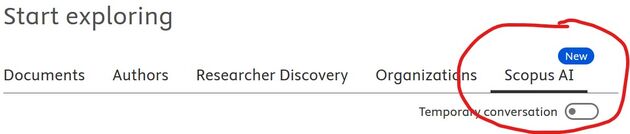
As of 1 January, 2026, KAU library offers access to Scopus AI. You will automatically have access when logging on to the Scopus database through the library pages.
Scopus is a comprehensive database containing bibliographic records and citation data. With Scopus AI, you can search using full questions or phrases – there is no need to use keywords or Boolean operators. The results are based on abstracts from the Scopus database and are presented as a summary with references, links to the underlying documents, and a concept map of the topic you searched for.
Back to top
|
|
|
|
|
|
|
|

|
|
The library’s research support is available for PhD students and researchers at Karlstad University to discuss your search strategy, search techniques and databases.
We can assist with all types of search requests at various levels, including more comprehensive systematic searches.
To book an individual search consultation, fill in the form here.
Back to top
|
|
|
|
|
|
|
|
|
|
During week 13 a new KAU service will be launched which makes it possible to fetch and show your confirmed ORCID in your research profile at kau.se.
Simultaneously any manually added ORCID in the research profile will be deleted.
To publish your confirmed ORCID, follow these steps:
-
Go to Inslaget.kau.se
-
Click on your profile icon in the top right corner
-
Click "Manage my profile"
-
Click "My details" and choose tab "Profile"
-
Choose ”Link ORCID iD” and follow instructions
Read more about ORCID and how to create a research profile here:
Back to top
|
|
|
|
|
|
|
|
|
|
The library's popular scientific podcast Forskningspodden is into its eleventh year of recording. In Forskningspodden newly graduated licentiate and doctoral students present their research findings in a compact and accessible format. Out of the total 145 published episodes, eight of them have been recorded and published this spring. Check them out here:
Back to top
|
|
|
|
|
|
|
|
|
|
Open Educational Resources (OER) are defined by Unesco as: "learning, teaching and research materials in any format and medium that reside in the public domain or are under copyright that have been released under an open license, that permit no-cost access, re-use, re-purpose, adaptation and redistribution by others."
Now, Sweden is about to get its own first national platform for OER. It will be launched on 10 April. Join this SUHF webinar to take part of the launch, and hear what the ideas behind the platform are and how it can be of use for you.
Sign up for the seminar by 7 April at the latest.
Back to top
|
|
|
|
|
|
|
|

|
|
Using other people's work without giving proper credit to the original source is the definition of plagiarism. According to the European Code of Conduct for Research Integrity, plagiarism is an act of research misconduct, as serious as falsifying or fabricating research results.
However, there are many different ways that plagiarism can occur. Are you familiar with them? If you want to learn more about plagiarism, and of how to stay clear from any accusations of misconduct, we recommend you to have a look at the resources listed below.
Back to top
|
|
|
|
|
|
|
|

|
|
The National Library of Sweden has recently launched a tool for researchers that want to conduct research on Swedish radio broadcasts. The tool is called Mediesök, and with it you can investigate transmissions from Sveriges Radio P1 station and most of Sveriges Radio's regional stations.
For legal reasons, researchers interested in using the service can only do this by visiting the National Library in Stockholm. You also need an account in the Swedish Media Database (SMDB).
Back to top
|
|
|
|
|
|
|
|

|
|
Stealth corrections, i.e. when a publisher makes changes to an already published article, are very hard to detect. The behaviour severly undermines the trustworthiness of the journal doing this, and it is a threat to research integrity more broadly.
As these corrections are difficult to trace, the research community can be grateful for science sleuths doing their best to find and report stealth corrections, as reported in this blog post authored by science sleuths René Aquarius, Floris Schoeters, Alex Glynn, and Guillaume Cabanac.
(PS. Shout out to Anton Tkachuk at the Department of Engineering and Physics for the reading tip! DS.)
Back to top
|
|
|
|
|
|
|
|