|
|
|
Here comes the library’s final newsletter of the year. It is hard to do justice to such an eventful year, but for someone like me who mostly works with publishing issues, the cliché of “challenges” seems to capture the theme of the year.
What I am mainly thinking of are the challenges faced by the academic publishing landscape – challenges that will continue into next year. The scientific community must devote increasing effort to preventing misleading or even fabricated research from spreading and undermining public trust in science.
It is encouraging that there are researchers who, on their own initiative and often in their spare time, engage in exposing poor research, for example through the PubPeer community. In November, we were delighted to welcome Anton Tkachuk, Associate Professor of Mechanical and Materials Engineering, to our library seminar series Meet a Researcher, where he shared his sleuth work scrutinising published research. Together with many other researchers worldwide active on PubPeer, Anton has helped to question and have flawed research retracted.
Dedicated individuals like Anton are invaluable, but far from sufficient to maintain quality in the publishing system. In a recently published appeal – the so-called Stockholm Declaration – authors Bernhard Sabel, President of the German University Association (DHV), and Dan Larhammar, Uppsala University and the Royal Swedish Academy of Sciences, call for joint action. Universities, academies, scientific organisations and research funders need to work together, for example to create publisher-independent mechanisms that can identify and prevent the spread of fake publications. The current situation, where poor research is spreading at an accelerating pace, not least aided by AI technology, is described as the greatest crisis science has ever faced.
To end on a more hopeful note – with another cliché – you are probably familiar with the idea that every crisis also carries opportunities? Personally, I believe 2026 will offer many opportunities for positive reform of the publishing landscape, moving away from the publication pressure that tempts publishers, editors and researchers to take shortcuts that undermine research integrity. Wouldn’t it be wonderful if 2026 became the year when Karlstad University’s motto Sapere Aude – dare to be wise guided all actors in the academic publishing system, not least those who engage with the system for the wrong reasons?
Happy holidays!
|
|
|
|
|
|
|
|
|
|
|
As we have reported earlier, our current transcription tool from Amberscript (Sunet Speech-to-text) will be phased out by the end of this year. Remember to download any transcript you have made with Amberscript that you want to save to you KAU computer or Sunet Drive, by 31 December at the latest.
The new system, Sunet Scribe, is now launched. Learn more on how to get access to it here.
Back to top
|
|
|
|
|
|
|
Interested in doing research on social media, i.e hashtag research?
We now have access to Retriever’s Social Media Archive, which makes it possible to freely search among over 1 billion posts from Instagram, Facebook, X, as well as various blogs and forums. The data is based on Retriever’s customers’ searches since 1 January 2013.
To access Retriever Social Media Archive either follow this link or:
1. Go to https://www.kau.se/en/library
2. Select "Retriever Business" from the list of databases ("Databases A-Ö")
3. In Retriever Business select "Social" from the header.
|
|
|
|
|
|
|
As you are probably aware, the library has a large number of open access agreements with publishers, allowing you to publish your research at a discounted rate or, in most cases, completely free of charge.
The national library consortium Bibsam negotiates most of these agreements on our behalf, and for 2026 a significant number have been renegotiated. We are glad to inform you that all agreements in place for 2025 will also remain valid next year.
Thanks to financial support from the research funders – the Swedish Research Council, Forte, Formas and Vinnova – we are also introducing a brand-new agreement with the open access publisher Pensoft, which offers publication in around 60 science journals.
To check whether we have an agreement covering your preferred journals, we recommend using the Scifree database. Enter the journal title or ISSN. If you see the KAU logo under the heading “Who pays?”, it means you do not need to pay any article processing charge, provided you are the corresponding author and use your KAU email address when communicating with the journal.
Back to top
|
|
|
|
|
|
|
|
|
|
Date: 6 February 2026
Time: 10:00–11:30
Location: Zoom
Target group: Primarily researchers at the early stages of their academic careers, but the webinar is also relevant for senior researchers and other stakeholders in research environments.
How are research funders’ views on merits changing?
The working group National Research Applications, Individual and Environment Support within the Swedish CoARA Chapter, coordinated by SUHF, invites you to a webinar where Formas, the Swedish Research Council, the Knowledge Foundation, and Vinnova will share how they are implementing the CoARA principles. The focus will be on broadened merit assessment and responsible research evaluation – with presentations, a panel discussion, and an interactive Q&A session.
Speakers:
-
Lucas Du Priest, Formas, Swedish Research Council for Sustainable Development
-
Teresa Ottinger, Swedish Research Council
-
Yvonne Fors, Knowledge Foundation
-
Anna Bergstrand, Vinnova, Sweden’s Innovation Agency
Moderator: Coco Norén, Pro-Vice-Chancellor, Uppsala University
Back to top
|
|
|
|
|
|
|
|
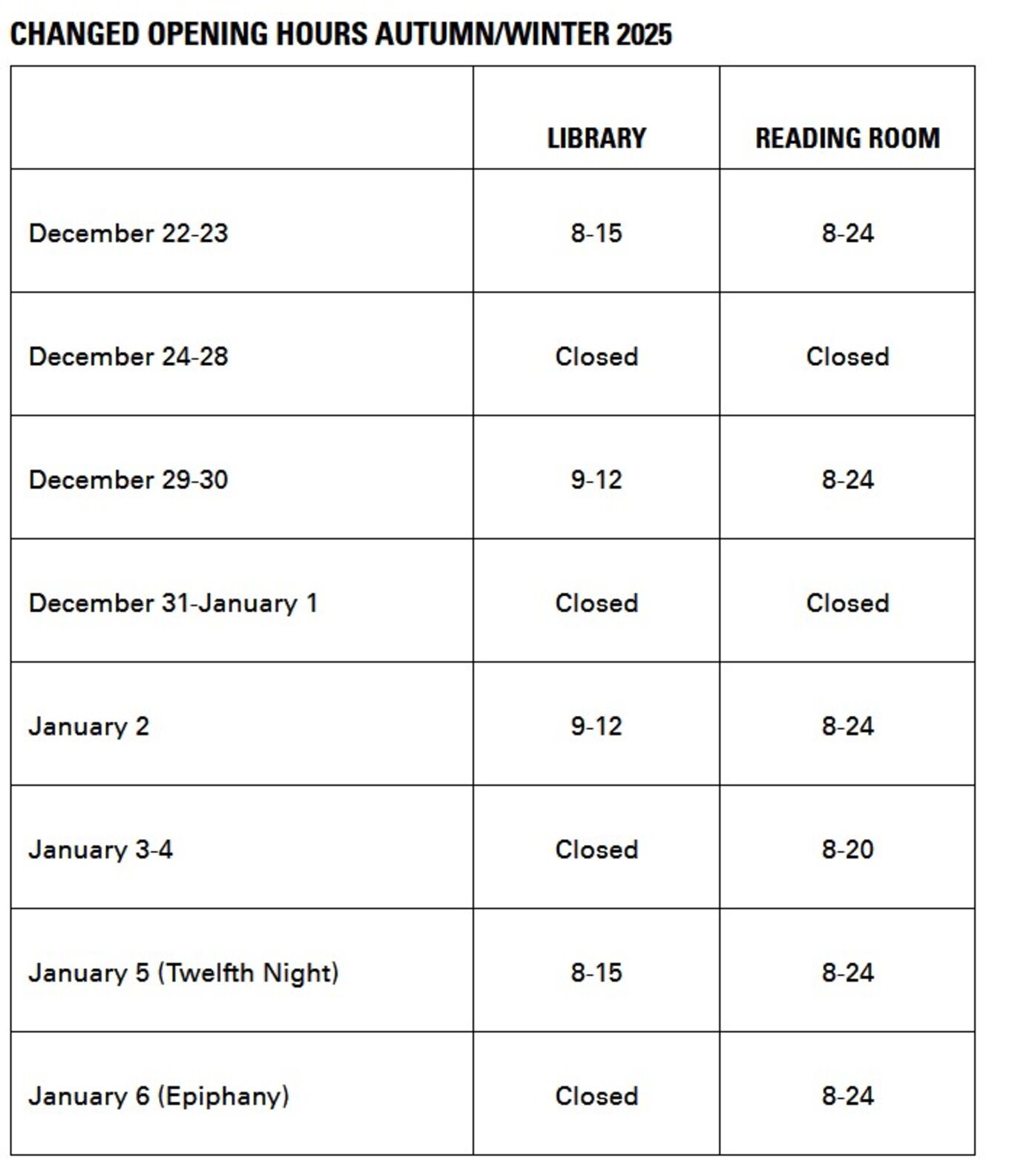
During the upcoming holidays the library's open hours will be changed slightly, see the chart below.
The library chat is open during library opening hours.
For any general library questions you are always welcome to contact us at:
biblioteket@kau.se
|
|
|
|
|